- Sustainability
- Article
- Reading time: 7 min
Toward a More Sustainable Future in Ophthalmology
Ophthalmic surgery is one of the highest-volume disciplines in modern medicine. In Germany alone, more than one million cataract procedures are performed every year – a number that continues to rise. With growing surgical volumes comes growing resource consumption: the single-use consumables required for each procedure generate significant waste and a considerable CO₂ footprint.
The critical question is not whether ophthalmology can do without single-use products – it cannot. Single use in eye surgery is a medical necessity, not a design choice. Sustainability in this context means more than simply reducing CO₂ emissions. Every unnecessary development iteration, every suboptimal material choice, every avoidable process step consumes energy, time and resources. What is wasted during development cannot be recovered later.
Why single use in ophthalmology is non-negotiable – and sometimes the more sustainable choice
Eye surgery – from cataract extraction and phacoemulsification to vitreoretinal procedures – demands sterility, reproducible material properties and complete documentation. Regulatory requirements are highly specific and can typically only be met with sterile-packaged, application-validated products.
Reusable solutions consistently fail in ophthalmology due to hygiene requirements, material fatigue and the risk of cross-contamination. avoid these reprocessing-related risks and therefore actively contribute to patient safety. What is often overlooked: in some cases, single use is also the more sustainable option, because reprocessing reusable products itself consumes significant resources.
The industry therefore faces a clearly defined challenge: not less single use, but more sustainable single use. What is needed is not broad climate commitments, but partners who understand material, design and manufacturing process as an integrated system – and develop sustainable solutions on a product-specific basis.
Three levers for more sustainable ophthalmic consumables
Sustainability can be addressed across the entire product lifecycle – from development and manufacturing through to end-of-life disposal. For ophthalmic single-use products, however, optimization options at the end of the lifecycle are limited by regulatory requirements and established disposal pathways. The greatest and most actionable levers therefore lie in product development itself. This is where the decisive choices are made regarding future resource consumption, CO₂ footprint and circularity.
Three areas offer the greatest potential:
- Material substitution in existing products using certified alternatives with an identical chemical structure – without changes to manufacturing processes
- Use of novel biopolymers in the development of new product platforms and packaging solutions
- Design for Sustainability, focusing on reduced material input, simplified product architecture and improved material separation at end of life
Material substitution as a lever for reducing the product carbon footprint
One of the most effective strategies for making ophthalmic single-use products more sustainable is the targeted substitution of fossil-based plastics with more sustainable polymer alternatives. Particularly relevant are so-called drop-in biopolymers: materials whose chemical structure and processing properties are identical to their fossil-based counterparts, but which are produced entirely or partially from renewable or circular raw materials.
The key advantage: because material properties remain largely unchanged, existing products can often be transitioned to more sustainable material variants without fundamental changes to design, tooling or manufacturing processes. This allows CO₂ emissions to be reduced along the value chain – without compromising functionality, quality or regulatory compliance.
For ophthalmic OEMs, this approach offers several concrete benefits:
- Reduction of the product carbon footprint through the use of bio-based or circular raw materials
- High material and process compatibility with existing manufacturing methods
- Lower qualification effort compared to switching to a different polymer class
- Retention of established mechanical, thermal and functional properties

“For RAUMEDIC, material selection is a key component of sustainable ophthalmology. That requires extensive know-how and broad practical experience.”
Jessica Hiller, Senior Materials Engineer
ISCC PLUS: sustainably certified raw materials
A particularly notable approach involves ISCC PLUS certified materials (ISCC = International Sustainability & Carbon Certification). ISCC PLUS is an internationally recognized standard for sustainable supply chains. It enables manufacturers to use sustainable raw materials transparently and traceably within existing processes – without compromising quality or safety.
At the heart of the concept is the mass balance approach: sustainably sourced raw materials are introduced at the beginning of the value chain and certified along it. Their share is accounted for and attributed to the end product – without requiring separate production lines.
For users, this delivers the advantages of a drop-in material with high availability and scalability:
- Up to 71 % less CO₂ compared to conventional fossil-based plastics (depending on raw material basis and application – to be assessed on a product-specific basis)
- Full compatibility with existing manufacturing processes such as extrusion or injection molding
- Unchanged material properties and product performance
- Complete traceability: ISCC PLUS guarantees independently verified transparency of raw materials throughout the entire supply chain
Potential analysis: up to 56 % lower CO₂ footprint for tubing material
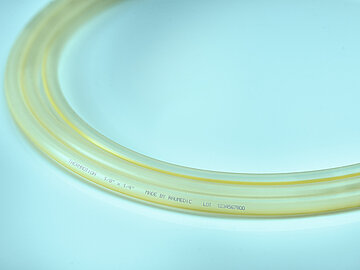
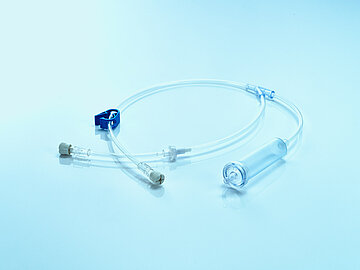
The potential of material substitution is illustrated by an internal RAUMEDIC analysis based on a tubing system used with a femtosecond laser. The study examined what impact replacing the existing tubing material with an ISCC PLUS-certified alternative would have on the product carbon footprint of the tubing component.

The result: the analysis identified a CO₂ reduction potential of up to 56 % for the tubing material compared to the conventional material variant – with no changes to geometry, material concept or manufacturing process.
This example demonstrates that switching to suitable alternative materials can unlock meaningful sustainability gains – even though the actual reduction at product level depends on the specific material proportions and product architecture involved.
This calculation shows that sustainability targets and medical device requirements need not be in conflict. Transitioning to an ISCC PLUS certified material can be carried out in a process-safe and reproducible manner, precisely because the material properties remain unchanged.
Sustainable product development with novel biopolymers
While drop-in biopolymers and ISCC PLUS certified materials are primarily an attractive solution for making existing products more sustainable, novel biopolymers open up additional possibilities in early-stage product development. Unlike drop-in alternatives, they represent new polymer classes whose chemical structure can differ significantly from established fossil-based polymers. This can affect not only origin and CO₂ footprint, but also processing, use and end-of-life properties.
For ophthalmic single-use products, this approach is particularly relevant where product design, material selection and manufacturing process are considered together from the outset. Novel biopolymers can, for example, open up potential for more resource-efficient components, tailored mechanical properties, optimized packaging solutions or new end-of-life concepts.
Unlike material substitution in existing products, the focus here is not primarily on replacing a fossil-based polymer with a chemically identical alternative. Instead, when developing a new single-use component, a novel biopolymer is selected with the specific application requirements in mind. This includes evaluating processability, sterilizability, biocompatibility, aging behavior, dimensional stability and regulatory suitability.

In addition to bio-based alternatives to established materials such as PVC, PP or PA, novel polymer classes such as CAP, Bio-PBS or PLA are also available. Depending on the application, these can offer additional potential in terms of resource efficiency, circularity and end-of-life management.
Design for Sustainability: engineering decisions with measurable impact
Alongside the selection of sustainable material alternatives, Design for Sustainability is today one of the most important levers for manufacturing excellence in ophthalmology – for example through reduced material input, fewer different materials, or a simplified product architecture that makes manufacturing and handling more efficient. Key decisions for more sustainable products can therefore be made as early as the development phase.
Many OEMs rely on standard components to control costs. The result: tubing lengths, diameters and component counts are often not tailored to the specific procedure, but systematically oversized – with corresponding consequences for material consumption. The “safety by bulk” approach also frequently leads to unnecessarily high material use. To avoid collapse effects (known as surge) during aspiration, for example, many manufacturers opt for thick-walled tubing or very rigid materials. Through application-specific design and targeted material selection, the same level of safety can often be achieved with significantly less material. This is precisely where innovative design can deliver meaningfully more sustainable components.
Intelligent design can maintain or even improve structural integrity and product performance – while simultaneously reducing material consumption.
50 % Less Material: Optimized Plunger Design Reduces Plastic Consumption
A customer project at RAUMEDIC illustrates this well. The goal was to analyze the geometry of a syringe plunger in detail and adapt it precisely to the actual requirements.
By designing the component specifically for polymer processing and injection molding, the customer’s new syringe design required approximately 50 % less plastic – while fully maintaining mechanical integrity, performance and tactile feedback for the surgeon. Functionality requirements were verified during the design phase using simulation tools, partly AI-assisted. As a result, waste generation and energy consumption in production were significantly reduced.

Reducing Material Mix Through Functional Integration
A further key principle of Design for Sustainability is the targeted reduction of material variety. In more complex ophthalmic single-use components, the use of multiple materials and additional process steps is often driven not by the product’s function itself, but by the way it is assembled – for example through adhesives, additional fasteners or auxiliary materials. Through structural functional integration, these materials can be avoided: components are designed to snap, plug or click together mechanically rather than being permanently bonded. This reduces not only the number of materials used, but often also assembly effort. At the same time, it improves the conditions for cleaner material separation and more efficient end-of-life processing.
A concrete example from a RAUMEDIC project shows how sustainability can be actively promoted through design optimization. The central question was whether an established adhesive bond was actually necessary.
In ophthalmology, many components are bonded together with adhesive – even though adhesives are almost always difficult to separate and dispose of. RAUMEDIC identified this as a weak point and replaced the adhesive entirely with specialized snap-fit connections.
The result was multi-layered:
- The number of materials used was reduced
- The assembly process was simplified
- The conditions for cleaner material separation at end of product life

Reduced number of materials: On the left is the glued version; on the right is the optimized version with a snap-fit connection
RAUMEDIC as a subsystem partner for sustainable ophthalmic polymer solutions
Ophthalmology does not need suppliers who deliver individual components – it needs partners who understand the complete application. In eye surgery, material decisions, design optimization, manufacturing processes and regulatory requirements are closely interconnected. Addressing only one of these areas will not produce sustainable improvements that extend beyond the product itself.
RAUMEDIC supports MedTech OEMs as a holistic development and manufacturing partner – and as a material and process partner for ophthalmic polymer subsystems. Every material decision is based on a product-specific assessment. Environmental progress and medical reliability are not weighed against each other; they are achieved together. The practical examples above show how this approach works in reality.

“RAUMEDIC sees sustainability above all as an opportunity – because the potential for sustainable processes, products and components is enormous, especially in ophthalmology. That requires a holistic perspective that encompasses fundamental product and material development, as well as the supply chain and the product lifecycle.”
Tobias Festel, Head of Design
Conclusion
Sustainability in ophthalmic surgery is not a question of whether – but of how. Single-use products are medically necessary in eye surgery and will remain so. What matters is how they are developed, what materials they are made from and how their supply chains are structured.
Material substitution based on ISCC PLUS certified drop-in biopolymers, design decisions guided by Design for Sustainability principles, and a transparent supply chain offer OEMs concrete, measurable approaches – without compromising performance, sterility or regulatory compliance. The examples presented here demonstrate that sustainability progress in ophthalmology is achievable today. Provided it is approached on a product-specific basis, and with the right partner.




Let’s connect