Technical and Surgical Accessories for Neuromonitoring Sterile and Non-Sterile Accessories for Measurement Purposes
RAUMEDIC provides a range of accessories for the application of its catheters and monitors. This includes items used for the sterile field of the catheter application, as well as cables and adapters for transmitting measured parameters to patient monitors.
Application and positioning of catheters
BOLT-DRILL KIT
The BOLT-DRILL KIT is a set of single-use sterile items designed to create access and provide secure fixation for NEUROVENT catheters on the skull of a patient. It consists of a Bolt and a Drill.
For the application of the catheters, it is necessary to pass through the calvaria using a drill and a suitable DRILL KIT. The DRILL bit size is selected to match the diameter of the BOLT screw. The DRILL KIT is disposable and for single use only, since it keeps its sharpness only for a short time due to the abrasive properties of the bone.
To safely position the measuring catheter, a BOLT is screwed into the drilled hole. By means of a screwing-in tool the BOLT is fixed in the skull and creates a seal for the drilling hole. The catheter is also firmly secured into the BOLT with the help of a flexible sealing cap. This way, the catheter is provided with a certain strain relief to protect it from damage caused by the patient's movements. The dura is opened using the atraumatic dura opener from RAUMEDIC.


Precise drilling for application of catheters
RALK-Hand Drill
The RALK-Hand Drill is used for preparing the drill hole. It is autoclavable and can therefore be used multiple times. The drill bit size is selected to match the diameter of the catheters.
Safe and secure positioning of NEUROVENT-PTO 2L BOLT
BOLT KIT PTO 2L
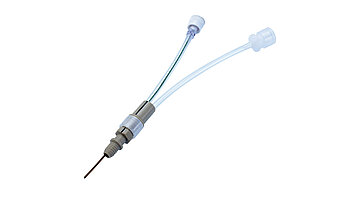
The BOLT KIT PTO 2L is a two-lumen BOLT which provides secure positioning of the NEUROVENT-PTO 2L BOLT and the microdialysis catheter through a single access port.
BOLT KIT PTO 2L ensures a safe positioning of the measuring catheters in the drilled hole. The BOLT is fixed in the skull with a screwing-in tool, creating a seal for the drilling hole. Because of the low height and the flexible lumens above the BOLT screw, the BOLT KIT PTO 2L is ideally suited for clinical applications.
Creating a tunnel below the scalp
Spliceable Tunneling Sleeve
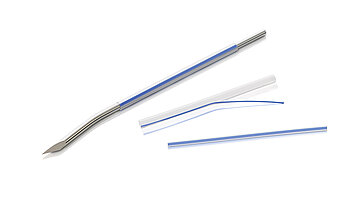
As an alternative to the safe positioning of the intracranial catheters with a BOLT screw, a tunnel can be created below the scalp. With the help of the RAUMEDIC Spliceable Tunneling Sleeve, the catheter is pulled through the tunnel, then the sleeve is spliced and removed leaving the catheter in place. The Spliceable Tunneling Sleeve is available in two versions: CH8 for parenchymal catheters and CH12 for ventricular catheters and the NEUROVENT-PTO 2L.
For subcutaneous tunneling
Tunneling KIT
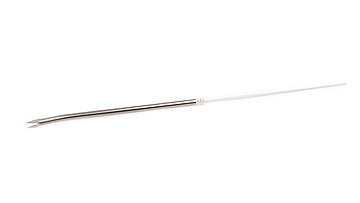
Another possibility for the application for subcutaneous tunneling is the Tunneling KIT CH8 and CH12. The fir-tree-like connection of the trocar provides a secure hold for the tunneling sleeve, which is cut off after being placed under the scalp.

Connecting RAUMEDIC catheters to patient monitors
Connection Cable ICP-TEMP-Cable and ICP-TEMP-Adapter
Depending on which RAUMEDIC catheter is used, different connection cables are available. To display the ICP (intercranial pressure) values on the patient monitor, an ICP-TEMP-Cable in connection with a NPS2 (zero-point-simulator) is required. To additionally display the temperature parameter on the patient monitor, the ICP-TEMP-Adapter must be used (as a jack plug; or for Philips/HP monitors in particular).
For zeroing procedures on patient monitors
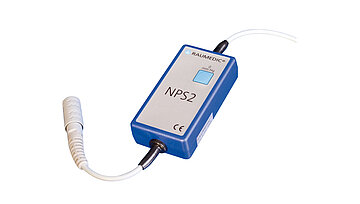
Zero-Point Simulator NPS2
The Zero-Point Simulator NPS2 is attached directly to the invasive blood pressure (IBP) port of the patient monitor. All RAUMEDIC catheters are calibrated in the manufacturing process and therefore are ready to use. The Zero-Point Simulator NPS2 is used to provide the monitor with an exact "zero" during the zeroing procedure.
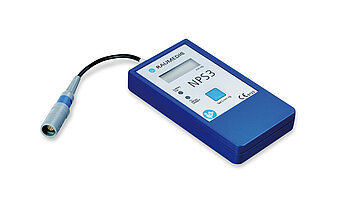
Measuring ICP during patient transport
NPS3 Mobile Transport Unit
The NPS3 is a battery-operated device for continued portable pressure measurement during patient transports. The ICP-TEMP-Cable can quickly and easily be disconnected from the NPS2 and connected to NPS3.
Displaying ICP and Oxygen Partial Pressure
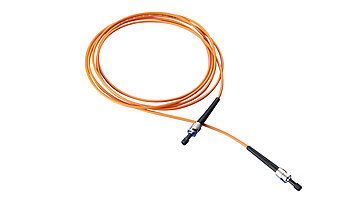
Cable PTO and Cable LWL
To measure oxygen partial pressure, Cable PTO and Cable LWL are the necessary cables which are connected to the RAUMEDIC devices. The optical Cable LWL hereby provides the oxygen signal, and the Cable PTO supplies intracranial pressure and temperature signals to the RAUMEDIC devices.
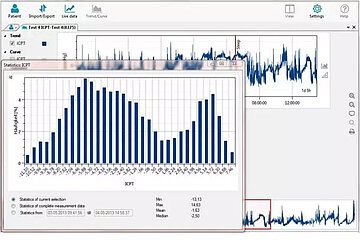
RAUMED DataView Software
With the proprietary RAUMED DataView software, parameters stored in the RAUMEDIC devices can be visualized and archived on the PC.